
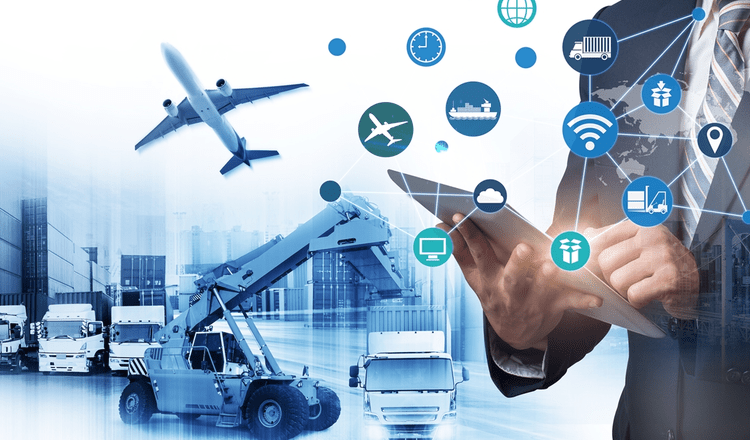
How Can Digitalisation Trends Enable End-to-End Supply Chain Collaboration?
First published in May 2023. Updated November 2026.

Digitalisation has touched every part of business, including supply chains. Technologies such as embedded sensors, GPS and RFID have helped companies turn traditional supply chains into more agile, flexible, open and collaborative digital models.
What is a digital supply chain?
In a typical supply chain, goods and services flow through sourcing raw materials and parts, designing and making the product, estimating demand, arranging sales channels and logistics, and giving customers visibility of their orders.
A digital supply chain gives far more visibility into how that chain works. It integrates advanced digital technology into every operation, from procurement data and inventory management to transportation and distribution.
The goal is better insight, leading to greater efficiency and profit. Companies that digitalise their supply chains can move resources, people, assets and inventory to where they are needed, and cut costs by responding early to transport and manufacturing risks. Advances in technology, tougher competition and the need for efficiency and visibility have all accelerated this trend.
Key digitalisation trends in supply chain management
Artificial intelligence (AI)
AI is a toolbox of technologies that helps companies understand complex information, enhance human performance and take over routine tasks, from demand prediction to automated planning.
Internet of Things (IoT)
IoT is a network of physical objects connected to the internet. It already plays a big role in supply chains, and its applications keep widening, from tracking shipments to monitoring warehouse conditions.
Blockchain
Blockchain helps reduce disruption and improve customer service by bringing carriers, shipping lines and logistics providers onto a single shared platform. Its transparency helps spot issues before they occur and cuts waste from data processing.
Big data analytics
By analysing large volumes of data from IoT sensors, social media, financial systems and other sources, companies get a more complete picture of supply chain performance. Typical uses include:
- Real-time monitoring of sensor data
- Risk management, flagging potential risks so action can be taken early
- Predictive analytics for future demand
- Inventory optimisation and cost reduction
- Transport optimisation, suggesting the most efficient routes to cut cost and emissions
Cloud computing and software-as-a-service (SaaS)
Cloud computing lets companies store and access data and applications remotely, without expensive on-premises infrastructure. That lowers cost, adds flexibility and improves disaster recovery.
SaaS applications, such as inventory, logistics and procurement software, run in the cloud and can be used from anywhere with an internet connection. They let multiple supply chain partners share information and collaborate in real time, wherever they are, improving visibility and coordination.
Digital twins
A supply chain digital twin is a virtual model of the network: warehouses, inventory, assets and logistics positions. Using AI and advanced analytics, it simulates performance, including the complexities that create risk, and helps teams spot opportunities in complex supply chains.
Virtual and augmented reality (VR and AR)
VR and AR create virtual views of supply chain operations, helping companies find bottlenecks and inefficiencies, test changes before making them in the real world, and collaborate with partners. In warehouses and factories, AR overlays instructions on the physical environment to guide picking, packing, assembly and maintenance, reducing errors and raising productivity.
Robotics and automation
Robotics and automation improve warehouse and distribution operations: material handling, picking and packing, inventory management, sorting, loading and unloading, and control of lighting, temperature, humidity and security through sensors.
Tracking technologies: RFID and GPS
Advanced tracking with RFID and GPS improves visibility and traceability across the supply chain.
How these trends enable end-to-end collaboration
- Automation of processes: manual work such as data entry, order tracking and inventory updates can be automated, increasing efficiency and reducing errors.
- Better communication: everyone in the supply chain can communicate and work together in real time, speeding up decisions and problem-solving.
- Greater visibility: products and materials can be tracked in real time, so bottlenecks are found and fixed sooner. A transparent, multi-tier view with scenario planning supports both tactical and strategic decisions, especially when critical components, sub-suppliers, high-risk regions and logistics networks are clearly mapped.
- Data-driven decisions: data collected across the supply chain reveals patterns, trends and potential issues, leading to better-informed decisions.
- Better supplier management: when purchase orders, deliveries and payments are digital, suppliers see the same data, progress is tracked easily, delays fall and production keeps running smoothly.
A fully realised digital supply chain saves time, resources and money, and reduces environmental footprint. To get the most from it, companies need to make digitalisation an integral part of their business model and organisation, not a separate IT project. Before you start, see the nine reasons supply chain digitalisation fails.
Frequently asked questions
What is the difference between digitisation and digitalisation?
Digitisation converts information into digital form, such as scanning paper records. Digitalisation uses digital technology to change how processes and businesses work, for example sharing live data with suppliers to plan together.
Which technology should a mid-sized manufacturer adopt first?
Start where visibility is weakest and the payback is clearest, often inventory accuracy, warehouse operations or dispatch planning, before moving to advanced tools such as digital twins.
At 7th Mile Shift, we help manufacturers build a practical supply chain digitalisation roadmap and implement tools such as WareIX and AllMileOps. Get in touch to discuss where to start.