
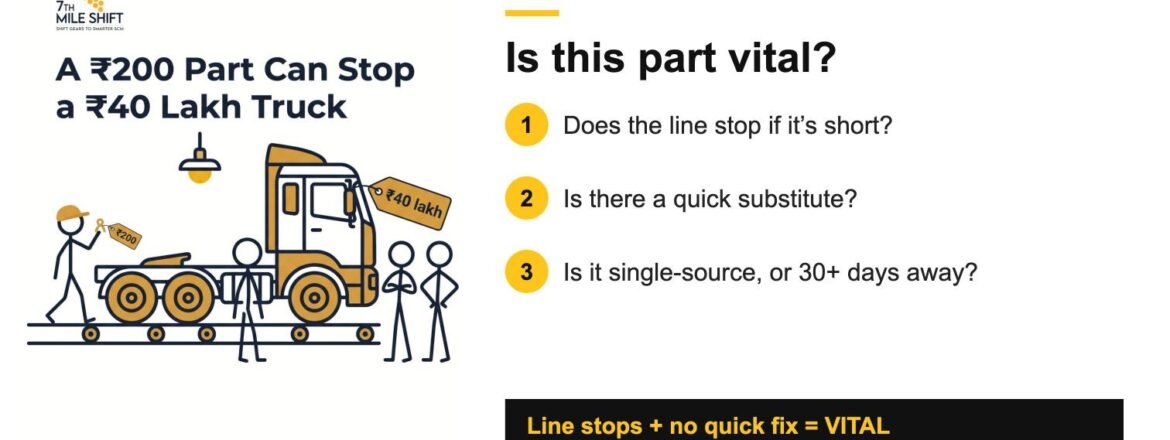
A ₹200 Part Can Stop a ₹40 Lakh Truck: Using ABC-VED Analysis to Protect Your Production Line
A ₹40 lakh truck is ready at the end of the assembly line, except for one fastener worth ₹200. It sits in the plant until that part arrives. Most plants have seen a version of this, and it usually traces back to how parts are classified for inventory control.
Why value-based inventory reviews miss the real risk
Most inventory reviews start with ABC analysis: rank every part by annual consumption value, give the A-class parts the most attention, and manage the C-class parts with bigger lots and less follow-up. It is a sound way to see where the money sits, and it keeps working capital under control.
The gap is that value says nothing about what happens when a part runs out. A low-cost bracket, seal or fastener often gets the least attention under ABC, yet a shortage of that one part can stop a line that builds products worth lakhs every hour. Value tells you where the money sits. Criticality tells you what keeps the line running. A plant needs both views.
What is VED analysis?
VED analysis classifies parts by how critical they are to operations, regardless of price:
- Vital (V): a shortage stops production, and there is no quick way around it.
- Essential (E): a shortage disrupts or slows production, but there is a workaround for a short period.
- Desirable (D): a shortage causes inconvenience but no real loss of output.
Used together, ABC and VED give each part two labels, one for value and one for criticality, and the inventory policy follows from the combination.
A three-question check to find vital parts
Criticality can sound subjective, so keep the test simple and ask the same three questions for every part:
- Does the line stop if this part is short?
- Is there a quick substitute? An alternate part, an approved equivalent, or a local source that can deliver within days.
- Is it single-source, or is the supply lead time more than 30 days?
If the line stops, and there is either no quick substitute or the supply is long or single-source, the part is vital. If the line slows but keeps running, it is essential. Everything else is desirable.
How to control vital parts
Once a part is marked vital, it gets three things, whatever it costs:
- A minimum service level. Set a target such as 98–99% availability, higher than the plant average.
- A buffer. Hold safety stock sized to the supply lead time and the variability of consumption, so one late delivery does not reach the line.
- A regular review. Check stock, open orders and supplier commitments on a fixed cadence, weekly for long-lead or single-source items.
For a ₹200 part, a larger buffer costs very little. The cost of not having it is measured in idle line hours and finished goods waiting for dispatch.
Combining ABC and VED: the ABC-VED matrix
Putting the two classifications side by side gives nine groups, each with its own control rule. A typical starting policy looks like this:
| Vital (V) | Essential (E) | Desirable (D) | |
|---|---|---|---|
| A – high value | Tight control: frequent review, safety stock, close supplier follow-up | Close control, moderate buffer | Lean stock, order closer to need |
| B – medium value | Buffer and regular review | Standard planning | Standard planning, lower service level |
| C – low value | Generous buffer, high service level, never left to chance | Larger lots, periodic review | Larger lots, minimal attention |
The key change is in the bottom-left cell. C-class vital parts, cheap but line-stopping, move from minimal attention to some of the strictest control in the plant. Because they are low value, holding extra stock of them adds little to working capital.
Make it a joint decision across production, purchase and planning
Criticality is a judgement call, and no single function sees the full picture. Production knows which shortages stop the line. Purchase knows which parts are single-source or come from far away. Planning knows consumption patterns and lead times. Answering the three questions together, part by part, gives a classification that all three teams trust and will act on.
A practical way to start:
- Pull the item master with annual consumption value and run a standard ABC classification.
- Shortlist parts with a history of line stoppages, single-source parts and long-lead parts.
- Hold a short joint review with production, purchase and planning to run the three-question check on the shortlist.
- Record the VED class in your ERP or item master so it drives reorder points and safety stock.
- Review the classification every quarter, and after any supplier change or line stoppage.
Frequently asked questions
What is the difference between ABC and VED analysis?
ABC analysis classifies inventory by annual consumption value, showing where money is tied up. VED analysis classifies inventory by how critical each item is to keeping operations running. ABC guides cost control; VED guides availability.
Should every C-class part be treated as low priority?
No. A C-class part can be vital if its shortage stops the line and it has no quick substitute. These C-vital parts need high service levels and buffers even though their value is low.
How often should VED classification be reviewed?
Review it at least once a quarter, and whenever there is a supplier change, a new product introduction or a line stoppage caused by a shortage.
In a well-run plant, the cheapest parts can get the strictest control
Value-based reviews keep money under control; criticality-based reviews keep the line running. Adding a simple VED check to your existing ABC review closes the gap between the two.
At 7th Mile Shift, we help mid-sized manufacturers set up inventory classification, safety stock and review routines that match how their plants actually run. Explore our inventory management services or get in touch to discuss your parts portfolio.
Which low-cost part has stopped your line most often?