
Same Demand, Same Supplier, Half the Stock: How Lot Size Sets Your Inventory
A worked example: the imported turbocharger
Take an imported turbocharger. The plant uses 60 a day, and each one costs ₹55,000.
Bring them in on a monthly container of 1,800, and on an average day about 900 sit in stock: roughly ₹4.95 crore. Switch to a fortnightly container of 900, and the average drops to about 450: roughly ₹2.48 crore.
| Monthly container | Fortnightly container | |
|---|---|---|
| Daily usage | 60 | 60 |
| Lot size (one container) | 1,800 | 900 |
| Average stock on hand | About 900 | About 450 |
| Value of average stock at ₹55,000 each | About ₹4.95 crore | About ₹2.48 crore |
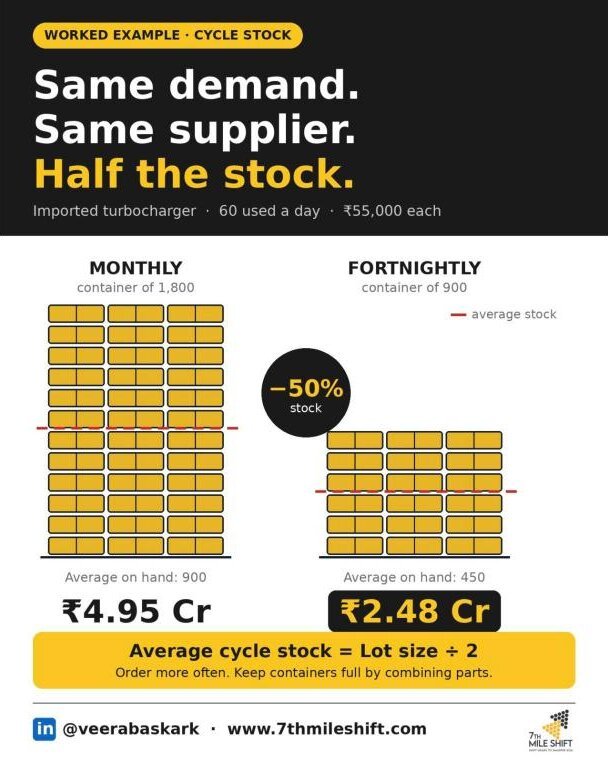
Same demand. Same supplier. Half the stock. Nobody had to plan harder; only the order rhythm changed.
How cycle stock works
This is cycle stock: the stock that builds up when a lot arrives and runs down as the plant uses it, until the next lot lands. Because it falls steadily from a full lot to nearly zero, on average you hold about half of every lot you bring in:
Average cycle stock = lot size ÷ 2
So the lot size, not the forecast or the planner, sets the stock level. Halve the lot and you halve the cycle stock, with no change in demand or service. Safety stock sits on top of this and is a separate decision.
What really sets the lot size
In most plants the lot size is not chosen by the planner at all. It is set by constraints that were agreed years ago and rarely questioned:
- Container fill: parts are ordered in whatever quantity fills a 20- or 40-foot container.
- Supplier minimum order quantities (MOQs): the smallest lot the supplier will ship.
- Changeover times: long set-ups push suppliers and in-house lines towards big batches.
- Truck and shipping frequency: a monthly sailing or a weekly truck fixes how often material can arrive.
Each of these can be revisited. A slightly smaller container, a negotiated MOQ, or a second monthly shipment can change the stock level far more than any planning tool.
The catch: freight
Smaller lots only pay off when the containers still go full. Shipping a half-empty container twice a month can cost more in freight than the inventory saving is worth.
The usual answer is to combine several parts from the same supplier or region into each shipment. Each part arrives twice as often in half the quantity, but every container still leaves full. Done well, inventory falls while freight cost per unit stays the same. Remember too that carrying cost is far more than interest, at about 26% of stock value a year, as explained in the real price of “just in case” stock. Every rupee of cycle stock removed saves roughly a quarter of that rupee each year.
Where to start
- List your top 20 imported or long-distance parts by inventory value.
- For each one, note the current lot size and what sets it: container fill, MOQ, changeover or shipping frequency.
- Work out the average cycle stock (lot size ÷ 2) and its value.
- Group parts by supplier or region, and test whether smaller lots can still fill each container.
- Check the freight impact before changing anything, and pilot with one supplier first.
Lot sizing works best alongside clear inventory classification. Our guide to ABC-VED analysis shows how to decide which parts deserve the closest attention.
Frequently asked questions
What is cycle stock?
Cycle stock is the inventory that comes in with each order and is used up before the next order arrives. On average it equals half the order quantity.
How is cycle stock different from safety stock?
Cycle stock covers normal usage between deliveries and depends on the lot size. Safety stock is an extra buffer against delays or demand spikes, and depends on lead-time and demand variability. Cutting the lot size reduces cycle stock without touching the safety buffer.
Does ordering more often always cost more?
Not if each shipment still goes full. Combining parts from the same supplier or region keeps containers full, so freight per unit stays about the same while inventory falls.
When did your team last question the lot size?
When did your team last ask why your biggest imported part arrives in the lot size it does? Often the answer is “that’s how it was set up”, and that is where the opportunity sits.
At 7th Mile Shift, we help mid-sized manufacturers set lot sizes, inventory norms and shipping patterns that free up cash without risking the line. See our inventory management and logistics and distribution services, or get in touch to review your top imported parts.
One Reply to “Same Demand, Same Supplier, Half the Stock: How Lot Size Sets Your Inventory”
Inventory Carrying Cost: The Real Price of “Just in Case” Stock
21 Nov 2026[…] of the quickest ways to cut stock without adding risk is to change the lot size. See same demand, same supplier, half the stock for a worked […]
Comments are closed.